
How to Write a Lab Report: A Complete Step-by-Step Guide for Students
If you have ever stared at a blank document after finishing a science experiment, unsure where to even begin, you are not alone. Writing a lab report is one of the most common academic assignments in STEM fields, and one of the most misunderstood. Many students think a lab report is just a record of what happened in the lab. In reality, it is a structured argument. It is a case you build, section by section, to show that your method was sound and your conclusions are supported by evidence.
This guide breaks down exactly how to write a lab report, step by step, with clear explanations of every section, practical examples, and tips that will help you write with more confidence and earn better grades.
What Is a Lab Report?
A lab report is a formal piece of academic writing that documents the aim, methods, results, and conclusions of a scientific experiment. Its core purpose is to demonstrate that you understand the scientific method — not just that you completed an experiment, but that you can design it, carry it out, analyze it, and explain what it means.
Lab reports are most common in biology, chemistry, physics, engineering, and other STEM disciplines. While formatting expectations can vary slightly between courses and institutions, most lab reports follow a similar structure.
The Standard Structure of a Lab Report
Before diving into each section in detail, here is an overview of what a typical lab report includes:
- Title
- Abstract
- Introduction
- Method (or Materials and Methods)
- Results
- Discussion
- Conclusion
- References
- Appendices
Not every report requires all nine sections. Some courses combine the Discussion and Conclusion, while others skip a separate Abstract for shorter assignments. Always check your instructor's specific requirements before you begin.
Step 1: Write a Clear, Informative Title
Your title is the first thing your reader sees, so it needs to communicate the focus of your study immediately. A strong lab report title is specific and descriptive rather than vague or creative.
Examples of effective lab report titles:
The Effects of Varying Nitrogen Levels on Tomato Plant Height
Comparing the Viscosity of Common Household Liquids
Testing the Universality of the McGurk Effect
Notice that each title states exactly what was tested and, often, what variable was measured. Avoid titles that are too broad ("A Study on Plants") or overly clever. Clarity always wins in scientific writing.
Step 2: Draft the Abstract Last
The abstract is a short summary, typically 150 to 300 words, that gives readers a compact preview of your entire report: your research aim, your methods, your key results, and your conclusion.
A useful tip that many students overlook: write your abstract last, after you have completed every other section. This way, you are summarizing work you have already finished rather than guessing at what you are about to write.
To draft a strong abstract, answer these guiding questions:
- What is the broader context of the study?
- What research question were you trying to answer?
- How did you carry out the experiment?
- What did your results show?
- How did you interpret those results?
- Why do your findings matter?
Write the abstract in the past tense, since you are summarizing completed work.
Step 3: Build a Focused Introduction
Your introduction sets the stage for everything that follows. The most effective structure for a lab report introduction is often described as a funnel, or an inverted triangle: you begin broad and end narrow.
Here is how that funnel works in practice:
Start with general background on your topic and explain why it matters in a real-world or theoretical context. Then narrow your focus by referencing previous research relevant to your specific study, explaining how your experiment confirms, expands, or fills a gap in that existing research. Finally, end with a clear, specific research question or hypothesis.
A strong introduction does not need to be long, but it should move logically from general context to your specific focus, and conclude by stating exactly what you expected to find and why.
Step 4: Describe Your Method With Enough Detail to Be Replicated
The Method section, sometimes called Materials and Methods, explains exactly how you carried out your experiment. This section should be detailed enough that another researcher could replicate your study using only what you have written.
A well-written method section typically includes:
Experimental design — Was this a between-subjects or within-subjects design? How were your samples or groups assigned to different conditions?
Subjects or samples — Describe what or who you studied, including relevant demographic or genetic details, total sample size, and how subjects were recruited or selected.
Materials — List every piece of equipment and material used, including model names for any specialized instruments.
Procedures — Describe, in chronological order, exactly what steps you took to collect your data. Write this section in the past tense, and keep it precise but concise. Long lists of detailed steps can be moved to an appendix if needed.
If you are conducting a statistical analysis, also state which tests you used and what software or tools supported your calculations.
Step 5: Report Your Results Clearly and Objectively
The Results section is where you present what you found, without yet interpreting what it means. That interpretation belongs in the Discussion section, which comes next.
In your Results section, include:
- Descriptive statistics relevant to your study
- The outcomes of any statistical tests performed
- The statistical significance of your findings
- Estimates of standard error or confidence intervals, where applicable
Keep this section factual. Avoid explaining why something happened here — simply report what the data showed.
Step 6: Write a Discussion That Makes Your Argument
This is the most important section of your entire lab report, and the one students most often underestimate. The Discussion typically makes up 40 to 45 percent of your total report, because this is where you analyze, interpret, and contextualize everything you have presented so far.
Like the introduction, the Discussion follows an hourglass structure, but in reverse: it starts narrow, focused on your specific hypothesis and results, and gradually widens to discuss the broader implications of your work.
A strong Discussion section should answer four essential questions:
1. Did you find what you expected to find? State clearly whether your results supported or did not support your hypothesis. Be careful with your language here — in scientific writing, you support or reject a hypothesis. You do not "prove" anything.
2. How do your findings compare to previous research? Bring in relevant literature. Do your results align with what other studies have found, or do they diverge? If they diverge, explore possible reasons why.
3. What are the implications of your findings? Explain why your results matter. How do they contribute to the broader field of research? What problem do they help solve, or what gap do they help fill?
4. What should be studied next? End by proposing direction for future research. What questions did your study raise that remain unanswered?
A good Discussion section should:
- Mirror the structure and scope of your introduction
- Clearly support or reject your hypotheses
- Compare your findings to existing research using cited literature
- Acknowledge limitations, anomalies, or sources of error in your study
- Suggest meaningful directions for future research
A good Discussion section should NOT:
- Repeat detailed results you already reported
- Refer back to specific tables, figures, or appendices
- Claim that anything was definitively "proven"
- Extrapolate conclusions beyond what your data actually supports
This is also where students should remember an important truth about lab reports: this section is not neutral reporting. It is argumentation. You are building a case, using your evidence to support a position, just as you would in any other persuasive academic writing.
Step 7: Sum Up With a Concise Conclusion
Not every lab report requires a separate Conclusion section — some courses fold this into the end of the Discussion. When a Conclusion is required, it should be brief and should restate your main findings and their significance without introducing new analysis.
Think of your conclusion as the final, confident statement of your case: here is what we found, here is what it means, and here is why it matters.
Step 8: Cite Your Sources Correctly
Any previous research you reference throughout your report — particularly in your introduction and discussion — needs to be properly cited using the citation style required by your course, commonly APA in STEM fields. Accurate citation strengthens your credibility and avoids academic integrity issues.
Step 9: Use Appendices for Lengthy Material
If your report includes long procedural steps, raw data tables, or detailed figures that would clutter the main body of your report, move them to an appendix. Reference the appendix within your text so readers know where to find the additional material.
Common Mistakes Students Make When Writing Lab Reports
Treating it as a simple record instead of an argument. Many students write lab reports as if they are merely documenting what happened. In reality, a strong lab report makes a case: this method was valid, these results are meaningful, and they support or challenge a specific hypothesis.
Mixing up verb tenses. Use the past tense for describing what you did and what you found ("the results supported the hypothesis"). Use the present tense to describe broader implications ("these results suggest that..."). Use future or conditional language only when proposing future research ("future studies should investigate...").
Overstating conclusions. Avoid saying your study "proved" something. In scientific writing, results support or reject a hypothesis; they rarely prove anything with absolute certainty.
Repeating results in the discussion. The Discussion should interpret your results, not restate them in detail. If you find yourself repeating numbers and statistics you already reported, shift your focus toward analysis and meaning instead.
Conclusion
Writing a strong lab report comes down to understanding what each section is for and how they work together to build a coherent, evidence-based argument. From a precise title to a Discussion section that interprets your findings with confidence, every part of your report should work toward the same goal: showing that you understand not just what happened in your experiment, but why it matters.
If you are working on a lab report and want feedback, editing, or guidance through the process, our academic writing team is here to help. We work with high school, college, and graduate students across STEM fields to strengthen scientific writing at every stage. From structuring your introduction to sharpening the argument in your discussion section.
education, Essaywriting, HigherEducation, how to write a lab report, writing a lab report step by step, STEM writing tips, lab report discussion section
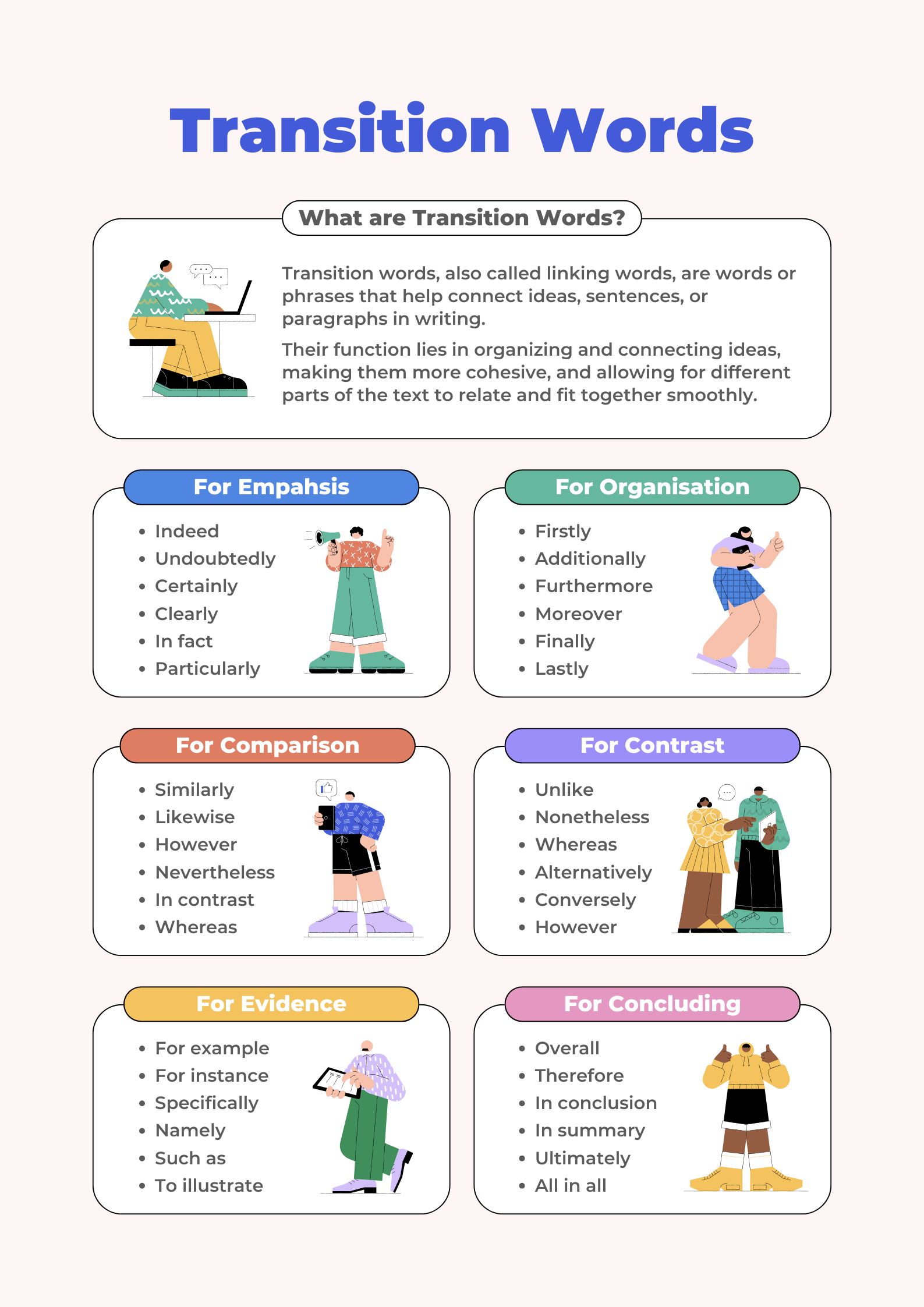
The Complete Guide to Transitional Expressions and Signal Words in Academic Writing
This complete guide lists every transition word by category, with examples, so your essays flow smoothly and earn higher grades.
If you have ever read an essay that felt choppy, disconnected, or hard to follow, chances are it was missing one crucial ingredient: transitional expressions. Also called signal words or linking phrases, transitional expressions are the glue that holds academic writing together. They guide your reader from one idea to the next, showing how your thoughts connect, contrast, build on each other, or lead to a conclusion.
Whether you are writing a college essay, a research paper, a literature review, or a narrative assignment, knowing how to use transitional expressions correctly is one of the fastest ways to improve your writing and boost your grades. This complete guide covers everything you need to know. What they are, why they matter, every major category with a full list, and real examples of how to use them.
What Are Transitional Expressions?
Transitional expressions (also called signal words, linking words, connective phrases, or transition words) are words and phrases that connect sentences, paragraphs, and ideas in a piece of writing. They signal to the reader what kind of relationship exists between two pieces of information.
Think of them as road signs. Just as a road sign tells a driver what is coming next — a turn, a stop, a merge, or a transition word tells a reader what kind of idea is coming next: an addition, a contrast, a cause, a conclusion.
Without transition words, writing feels abrupt and hard to follow. With them, writing flows naturally and feels polished and professional.
Why Are Transitional Expressions Important in Academic Writing?
In academic writing specifically, transitional expressions serve three critical functions:
1. Coherence — They connect ideas logically so that the argument builds in a clear, organized way. A well-transitioned paragraph shows the reader how each sentence relates to the one before it.
2. Clarity — They eliminate ambiguity. When you write "however," the reader immediately knows a contrasting idea is coming. When you write "therefore," the reader knows a conclusion or result is being stated. There is no guesswork.
3. Flow — They prevent your writing from sounding choppy or list-like. Instead of a series of disconnected statements, your writing becomes a smooth, connected argument that is enjoyable to read.
Professors and instructors look for the skillful use of transitions as a mark of academic maturity. Essays that use transitions well consistently score higher on organization and coherence rubrics.
The 8 Categories of Transitional Expressions (With Complete Lists and Examples)
Transitional expressions are organized by the type of relationship they signal. Here are all eight major categories, complete with word lists and example sentences.
1. Addition Transitions — Adding More Information
Use these when you want to introduce another point that supports or expands on what you just said.
Word List:
- Furthermore
- Moreover
- Additionally
- In addition
- Also
- Besides
- What is more
- Not only… but also
- As well as
- On top of that
- Equally important
- To add to this
Examples in sentences:
The study found that students who read daily performed better on standardized tests. Furthermore, they demonstrated stronger critical thinking skills across all subject areas.
The advertisement uses warm, inviting colors to attract consumers. In addition, it features a trusted mascot to build emotional connection with the brand.
Regular exercise improves cardiovascular health. Moreover, it has been shown to reduce symptoms of anxiety and depression.
2. Contrast and Concession Transitions — Showing a Difference or Opposing Idea
Use these when you want to introduce an idea that differs from, qualifies, or contradicts the previous point.
Word List:
- However
- Nevertheless
- Nonetheless
- On the other hand
- In contrast
- Conversely
- Yet
- Although
- Even though
- Despite this
- In spite of
- While
- Whereas
- That said
- Still
- By contrast
- At the same time
- On the contrary
Examples in sentences:
Many students believe that longer essays are more impressive. However, quality of argument matters far more than quantity of words.
The advertisement makes bold claims about the product's effectiveness. Nevertheless, no scientific evidence is provided to support these assertions.
Social media has made communication faster and more accessible. On the other hand, studies suggest it has also contributed to increased feelings of isolation among young adults.
3. Sequence and Order Transitions — Showing Order, Steps, or Priority
Use these when presenting steps in a process, ranking ideas by importance, or organizing information chronologically.
Word List:
- First and foremost
- First, second, third
- To begin with
- Initially
- Next
- Then
- Subsequently
- Following this
- After that
- Meanwhile
- At the same time
- Before
- Previously
- Finally
- Lastly
- Last but not least
- In the first place
- To start with
Examples in sentences:
First and foremost, a strong thesis statement is essential to any well-organized academic essay.
To write an effective narrative, first identify your main point. Then gather all relevant details and sensory descriptions. Finally, organize them in a sequence that serves your purpose.
Initially, the researcher observed no significant changes in the subjects' behavior. Subsequently, however, notable patterns began to emerge.
4. Cause and Effect Transitions — Showing Reasons and Results
Use these when explaining why something happened or what resulted from an action or event.
Word List:
- Therefore
- Thus
- Consequently
- As a result
- Hence
- For this reason
- Because of this
- This led to
- Due to
- Owing to
- Since
- Because
- It follows that
- As a consequence
- Accordingly
- So
- This means that
Examples in sentences:
The advertisement targets the audience's insecurities about social status. As a result, consumers are more likely to purchase the product as a way of seeking validation.
The study participants were not informed of the experiment's true purpose. Therefore, their responses can be considered more authentic and unbiased.
Bell Hooks states her main point clearly at the beginning of her essay. Consequently, readers immediately understand the significance of the narrative that follows.
5. Emphasis Transitions — Stressing the Most Important Point
Use these when you want to draw particular attention to a point or make it stand out.
Word List:
- Indeed
- In fact
- Above all
- Most importantly
- Significantly
- Notably
- Crucially
- Especially
- Particularly
- Of particular importance
- It is worth noting that
- What is especially significant is
- More than anything
- Without doubt
- Clearly
- Undeniably
Examples in sentences:
The ad's visuals are carefully designed to appeal to domestic pride. Most importantly, they position the product as a symbol of quality rather than a mere grocery item.
Indeed, the use of first-person narration in the essay creates an immediate and powerful sense of intimacy with the reader.
Transitional expressions improve the flow of an essay. Above all, they signal to the reader that the writer has a clear, organized argument.
6. Illustration and Example Transitions — Providing Evidence or Examples
Use these when you are about to offer a specific example, case, or piece of evidence to support your point.
Word List:
- For example
- For instance
- To illustrate
- As an illustration
- Specifically
- In particular
- Such as
- As shown by
- As evidenced by
- To demonstrate
- Consider
- Take the case of
- A case in point is
- Including
- Namely
Examples in sentences:
Narratives appear across many academic disciplines. For example, in medicine, patient histories play a key role in diagnosis and treatment.
Many advertisements exploit cultural insecurities to sell products. To illustrate, the Heinz Ketchup ad links the product to domestic excellence, implying that a homemaker who chooses Heinz is making a sophisticated, tasteful choice.
Code-switching is used by writers for various purposes. Specifically, it can help connect with a particular audience or vividly evoke a community's culture.
7. Comparison Transitions — Showing Similarity
Use these when pointing out that two ideas, examples, or situations are alike in some way.
Word List:
- Similarly
- Likewise
- In the same way
- In a similar manner
- Correspondingly
- Just as
- By the same token
- Equally
- In comparison
- Compared to
- Along the same lines
Examples in sentences:
Bell Hooks opens her essay by stating her main point directly. Similarly, Roxane Gay positions her thesis early in her speech to give her audience immediate context.
Just as a road sign tells a driver what lies ahead, a transition word tells a reader what kind of idea is coming next.
The narrative essay requires a clearly identified event and vivid descriptive detail. Likewise, the literacy narrative depends on a firsthand account with a clear indication of its significance.
8. Summary and Conclusion Transitions (Wrapping Up)
Use these at the end of a paragraph or essay when you are restating your main point, drawing a conclusion, or bringing the discussion to a close.
Word List:
- In conclusion
- In summary
- To summarize
- To conclude
- Overall
- Ultimately
- In short
- In brief
- To sum up
- All in all
- On the whole
- As has been shown
- As demonstrated above
- Taking everything into account
- In the final analysis
- It is clear that
- The evidence suggests that
Examples in sentences:
In conclusion, the Heinz Ketchup advertisement successfully transforms a common grocery item into a symbol of domestic pride and social approval.
Ultimately, the most effective narratives do more than recount events — they make a clear and meaningful point that resonates with the audience.
All in all, mastering transitional expressions is one of the most practical and immediately impactful skills any student can develop as an academic writer.
How to Use Transitional Expressions Correctly: 5 Rules Every Student Should Know
Knowing the words is only half the battle. Here is how to use them correctly in your writing.
· Rule 1: Match the transition to the relationship. If you are contrasting two ideas, use a contrast transition like however or on the other hand — not an addition transition like furthermore. Using the wrong transition is more confusing than using none at all.
· Rule 2: Use a comma after most transitional expressions at the start of a sentence.
However*,** the results were inconclusive.* Furthermore*,** the study lacked a control group.*
· Rule 3: Do not overuse transitions. Every sentence does not need a transition word. Use them where they genuinely signal a shift or connection. Overusing them makes writing feel mechanical and repetitive.
· Rule 4: Vary your transitions. Using however ten times in one essay becomes repetitive. Draw from across the categories to keep your writing varied and sophisticated.
· Rule 5: Transitions work between paragraphs too. The opening sentence of a new paragraph is an excellent place for a transition that links back to the previous paragraph's main idea. This keeps your entire essay cohesive, not just individual sentences.
Quick Reference Chart: All Transition Words by Category
|
Category |
Purpose |
Key Examples |
|
Addition |
Add information |
Furthermore, moreover, additionally, also |
|
Contrast |
Show difference |
However, nevertheless, on the other hand, yet |
|
Sequence |
Show order |
First, then, subsequently, finally |
|
Cause & Effect |
Show reason/result |
Therefore, consequently, as a result, thus |
|
Emphasis |
Stress importance |
Indeed, above all, most importantly, notably |
|
Illustration |
Give examples |
For example, for instance, specifically |
|
Comparison |
Show similarity |
Similarly, likewise, in the same way |
|
Conclusion |
Wrap up |
In conclusion, ultimately, overall, in short |
Conclusion
Transitional expressions are not decorative flourishes — they are functional tools that make the difference between an essay that is hard to follow and one that reads with authority and clarity. From the opening paragraph to the conclusion, signal words guide your reader through your argument, showing exactly how your ideas connect, contrast, build, and resolve.
If you are working on an essay and your paragraphs feel disconnected or your argument feels unclear, go back and look at your transitions first. Adding or improving them is often the single fastest fix available.
Need personalized help with your academic writing? Our team of expert consultants is available to review your essays, strengthen your arguments, and help you develop the writing skills you need to succeed at every level of your academic journey.
education, Essaywriting, UKstudents, HigherEducation, ResearchWriting, transitional expressions, how to use transitions in essays
Where to Find Free Primary Sources for Research Papers and Academic Writing
One of the most common questions I get from students and academic writers is, "Where can I find good primary sources without paying for expensive databases?"
The good news is that quality research does not always require a subscription. Several excellent platforms provide access to primary sources completely free or through institutional access that many students already have.
What Are Primary Sources?
Before diving into where to find them, let's clarify what primary sources actually are.
Primary sources are original materials created during the time period being studied or by individuals directly involved in an event, issue, or research topic. Examples include:
- Diaries and journals
- Interviews
- Letters and correspondence
- Government documents
- Court records
- Speeches
- Historical photographs
- Newspaper archives
- Original research studies
- Census records
Using primary sources strengthens your academic work because you are analyzing evidence directly rather than relying solely on someone else's interpretation.
1. JSTOR
JSTOR is one of my favorite resources for academic research.
Many students assume JSTOR is only available through paid subscriptions, but that's not always true. If you attend a college or university, try logging in through your institution's library portal. You may already have access without realizing it.
Even if your school does not subscribe, JSTOR offers a significant collection of free content that can be accessed by creating an account.
JSTOR is particularly useful for:
- Historical documents
- Academic journal articles
- Archival materials
- Original research publications
- Literature and humanities research
2. Library of Congress
The Library of Congress is an absolute goldmine for students conducting research.
Its digital collections contain millions of primary source materials covering history, politics, culture, literature, social movements, and much more.
You can find:
- Historical photographs
- Maps
- Presidential speeches
- Government records
- Manuscripts
- Letters
- Newspaper archives
- Oral histories
The archive is extensive, well organized, and completely free to explore.
Other Free Sources Worth Exploring
National Archives
The National Archives provides access to historical government records, treaties, military documents, and presidential materials.
Google Scholar
While not exclusively a primary source database, Google Scholar can help you locate original research studies and academic publications that may be available for free.
Project Gutenberg
Students studying literature can access thousands of original texts and historical works that are now in the public domain.
Internet Archive
The Internet Archive contains digitized books, historical media, documents, and collections that can support academic research across many disciplines.
Final Thoughts
Many students believe that good research requires expensive databases, but that is often not the case. Knowing where to look can save both time and money.
If you are writing essays, discussion posts, reflections, capstone projects, or research papers, resources like JSTOR and the Library of Congress can provide direct access to the evidence you need to build stronger arguments and improve the quality of your work.
The next time you are stuck searching for credible sources, start with these platforms before reaching for your wallet.
education, Essaywriting, UKstudents, US students, HigherEducation, ResearchWriting
Understanding Implications in Research Writing
One of the most misunderstood sections in academic writing is the discussion of implications.
Many college and university students, especially those writing research papers, dissertations, capstone projects, or thesis papers, confuse implications with simple advantages and disadvantages. While these concepts may overlap slightly, they are not the same thing.
Understanding implications properly can significantly improve the quality of your academic writing and help you demonstrate deeper critical thinking in higher education research.
What Are Implications in Research?
In academic research, implications refer to the possible effects, consequences, significance, or impact of your findings.
They answer questions such as:
- Why do these findings matter?
- What could happen because of this research?
- How might this affect future studies, policies, industries, education, healthcare, or society?
- What should readers take away from these findings?
Implications move beyond simply describing results. They explain the broader meaning and relevance of your research.
Why Students Confuse Implications With Advantages and Disadvantages
This confusion happens because students are often taught to think in basic “pros and cons” structures during earlier stages of education.
For example:
- Advantage = something positive
- Disadvantage = something negative
But implications are more analytical and academic.
An implication does not have to be strictly positive or negative. Instead, it focuses on the possible outcomes, significance, or future effects connected to the research findings.
Example
Weak implication:
“Online learning is advantageous because students can study from home.”
This sounds more like a benefit than a research implication.
Stronger implication:
“The findings suggest that universities may need to expand flexible online learning options to support non-traditional students and working professionals.”
Notice the difference? The second example explains the broader impact of the findings on higher education policy and practice.
Types of Implications in Academic Research
Depending on your subject, research papers may include several kinds of implications.
Practical Implications
These explain how findings can be applied in real-world settings.
For example:
- Changes in workplace policies
- Improvements in healthcare practices
- Educational reforms
- Business strategy adjustments
Theoretical Implications
These discuss how the research contributes to academic theories, concepts, or existing literature.
This is especially important in postgraduate research, dissertations, and PhD-level writing.
Social Implications
These focus on how findings may affect society, communities, culture, or public behavior.
Policy Implications
These examine how governments, institutions, or organizations may use the findings to guide decisions or regulations.
How to Write Strong Implications in Research Papers
Many students struggle with this section because they only repeat their results instead of interpreting them.
A strong implications section should:
- Connect findings to larger issues
- Explain the significance of the research
- Discuss future possibilities
- Show critical thinking
- Demonstrate academic analysis
Here are a few helpful questions to ask yourself:
- Why do these findings matter?
- Who could benefit from this research?
- What changes could happen because of these findings?
- What future research should explore this topic further?
Common Mistakes Students Make
Confusing implications with recommendations
Recommendations tell readers what actions should be taken. Implications explain why the findings matter.
Repeating results instead of analyzing them
Do not simply restate your findings. Explain their meaning and impact.
Writing vague statements
Avoid generic phrases like:
- “This research is important.”
- “The findings may help people.”
Be specific about who benefits and how.
Focusing only on positives and negatives
Research implications are more complex than advantages and disadvantages. Academic writing requires deeper interpretation.
Why Understanding Implications Matters in Higher Education
Whether you are writing a college essay, university dissertation, research proposal, literature review, or thesis paper, understanding implications helps strengthen your academic argument.
Professors and lecturers often look for:
- Critical thinking
- Depth of analysis
- Ability to connect ideas
- Awareness of broader significance
Students who write strong implications sections usually produce more advanced and persuasive research papers.
Final Thoughts
Learning how to discuss implications is one of the biggest transitions students make in higher education writing.
At first, many learners approach research papers by simply listing findings or discussing pros and cons. But strong academic writing goes further. It explains why research matters and how findings connect to larger conversations, systems, and future developments.
Once students understand this difference, their research writing becomes far more analytical, thoughtful, and academically credible.
education, Essaywriting, essaytips, UKstudents, US students, HigherEducation, ResearchWriting, Implications
Why Your Essays Are Not Reaching Their Full Potential: Understanding the Analytical Paragraph Structure (APS)
Have you ever submitted an essay feeling confident that you followed every instruction, addressed the grading rubric, and included enough research—only to receive a disappointing grade?
If so, you are not alone.
Many students in US colleges, UK universities, master's programs, and PhD programs struggle with academic writing not because they lack knowledge, but because they do not fully understand how to structure their arguments. One of the most overlooked writing skills is mastering the Analytical Paragraph Structure (APS).
What Is the Analytical Paragraph Structure (APS)?
The Analytical Paragraph Structure is a framework used in academic writing to help students present clear, logical, and persuasive arguments. Whether you are writing an essay, research paper, literature review, or dissertation chapter, APS provides a reliable structure for communicating your ideas effectively.
The structure consists of four key components:
Claim → Evidence → Explanation → Closing
When used correctly, APS transforms a paragraph from a collection of facts into a coherent academic argument.
Step 1: Make a Clear Claim
A claim is the main point or argument of the paragraph. Unlike a simple fact, a claim is something that can be debated or interpreted differently.
Weak Example
"Social media exists in modern society."
This is a fact, not a claim.
Strong Example
"Social media has significantly changed how young adults form and maintain relationships."
This statement is arguable and provides a clear direction for analysis.
Step 2: Support the Claim with Evidence
Once you have made a claim, you need evidence to support it. In academic writing, evidence serves the same purpose it does in a courtroom—it helps convince readers that your argument is valid.
Evidence may include:
- Research findings
- Statistics
- Expert opinions
- Academic sources
- Case studies
- Examples
- Direct quotations
Example
According to researcher Sherry Turkle, digital communication can sometimes create "the illusion of companionship without the demands of friendship."
Notice that the evidence is introduced with a signal phrase: According to researcher Sherry Turkle.
Signal phrases help readers understand where information originates and improve the flow of academic writing.
Step 3: Explain the Evidence
This is the section many students overlook.
A common mistake is to insert a quotation and immediately move on to the next point. However, professors and instructors are often looking for your analysis—not just your ability to find sources.
Example
Turkle's observation supports the claim because it suggests that while social media increases opportunities for communication, it may also reduce the depth of interpersonal relationships. This demonstrates how digital interactions can alter traditional relationship-building processes.
The explanation connects the evidence directly back to the claim and shows critical thinking.
Step 4: Close the Paragraph
A strong closing sentence reinforces the paragraph's main idea and creates a smooth transition to the next point.
Example
Therefore, although social media increases connectivity, it may simultaneously weaken the quality of personal relationships.
The closing reminds readers of the argument and gives the paragraph a sense of completion.
Putting It All Together
Claim
Social media has significantly changed how young adults form and maintain relationships.
Evidence
According to researcher Sherry Turkle, digital communication can create "the illusion of companionship without the demands of friendship."
Explanation
This suggests that online interactions may increase communication frequency while reducing emotional depth, ultimately reshaping relationship dynamics.
Closing
Therefore, social media has transformed not only how people communicate but also the quality of their interpersonal connections.
Why APS Matters for Academic Success
The Analytical Paragraph Structure is one of the most important academic writing skills for college, master's, and PhD students. It helps writers:
- Develop stronger arguments
- Improve critical thinking
- Create logical paragraph flow
- Integrate research effectively
- Meet university-level writing expectations
- Earn higher grades on essays and research papers
Many students believe their essays are losing marks because of grammar or formatting. In reality, instructors often deduct points because paragraphs lack clear analysis and logical development.
Final Thoughts
Strong academic writing is not about using complex vocabulary or writing longer essays. It is about presenting ideas logically and supporting them with meaningful analysis.
If your essays are not receiving the grades you expect, take a closer look at your paragraph structure. By mastering the Analytical Paragraph Structure (Claim → Evidence → Explanation → Closing), you can improve the clarity, depth, and effectiveness of your academic writing.
At our academic support center, we help students develop essential essay writing, research, and dissertation skills needed for success in US and UK higher education institutions.
education, Essaywriting, essaytips, UKstudents, US students, HigherEducation, ResearchWriting
Subcategories
Student life comes with real challenges — tight deadlines, complex topics, and balancing studies with personal responsibilities. That’s where we come in. We provide ethical academic support and learning assistance to help students understand their subjects, improve their research skills, and present their work with confidence. Our goal is to support your learning journey, not replace it.
 How can i help you?
