
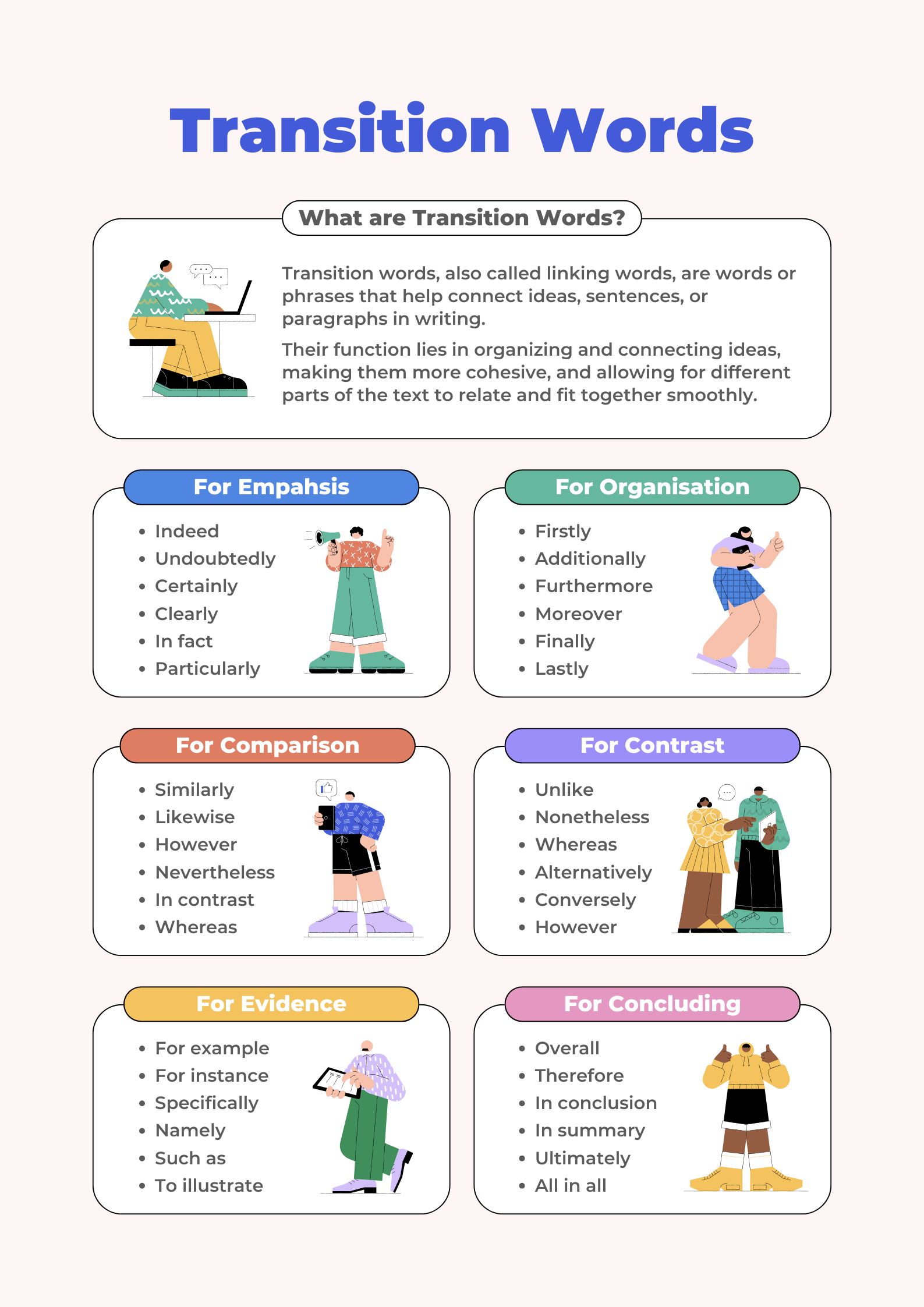
The Complete Guide to Transitional Expressions and Signal Words in Academic Writing
This complete guide lists every transition word by category, with examples, so your essays flow smoothly and earn higher grades.
If you have ever read an essay that felt choppy, disconnected, or hard to follow, chances are it was missing one crucial ingredient: transitional expressions. Also called signal words or linking phrases, transitional expressions are the glue that holds academic writing together. They guide your reader from one idea to the next, showing how your thoughts connect, contrast, build on each other, or lead to a conclusion.
Whether you are writing a college essay, a research paper, a literature review, or a narrative assignment, knowing how to use transitional expressions correctly is one of the fastest ways to improve your writing and boost your grades. This complete guide covers everything you need to know. What they are, why they matter, every major category with a full list, and real examples of how to use them.
What Are Transitional Expressions?
Transitional expressions (also called signal words, linking words, connective phrases, or transition words) are words and phrases that connect sentences, paragraphs, and ideas in a piece of writing. They signal to the reader what kind of relationship exists between two pieces of information.
Think of them as road signs. Just as a road sign tells a driver what is coming next — a turn, a stop, a merge, or a transition word tells a reader what kind of idea is coming next: an addition, a contrast, a cause, a conclusion.
Without transition words, writing feels abrupt and hard to follow. With them, writing flows naturally and feels polished and professional.
Why Are Transitional Expressions Important in Academic Writing?
In academic writing specifically, transitional expressions serve three critical functions:
1. Coherence — They connect ideas logically so that the argument builds in a clear, organized way. A well-transitioned paragraph shows the reader how each sentence relates to the one before it.
2. Clarity — They eliminate ambiguity. When you write "however," the reader immediately knows a contrasting idea is coming. When you write "therefore," the reader knows a conclusion or result is being stated. There is no guesswork.
3. Flow — They prevent your writing from sounding choppy or list-like. Instead of a series of disconnected statements, your writing becomes a smooth, connected argument that is enjoyable to read.
Professors and instructors look for the skillful use of transitions as a mark of academic maturity. Essays that use transitions well consistently score higher on organization and coherence rubrics.
The 8 Categories of Transitional Expressions (With Complete Lists and Examples)
Transitional expressions are organized by the type of relationship they signal. Here are all eight major categories, complete with word lists and example sentences.
1. Addition Transitions — Adding More Information
Use these when you want to introduce another point that supports or expands on what you just said.
Word List:
- Furthermore
- Moreover
- Additionally
- In addition
- Also
- Besides
- What is more
- Not only… but also
- As well as
- On top of that
- Equally important
- To add to this
Examples in sentences:
The study found that students who read daily performed better on standardized tests. Furthermore, they demonstrated stronger critical thinking skills across all subject areas.
The advertisement uses warm, inviting colors to attract consumers. In addition, it features a trusted mascot to build emotional connection with the brand.
Regular exercise improves cardiovascular health. Moreover, it has been shown to reduce symptoms of anxiety and depression.
2. Contrast and Concession Transitions — Showing a Difference or Opposing Idea
Use these when you want to introduce an idea that differs from, qualifies, or contradicts the previous point.
Word List:
- However
- Nevertheless
- Nonetheless
- On the other hand
- In contrast
- Conversely
- Yet
- Although
- Even though
- Despite this
- In spite of
- While
- Whereas
- That said
- Still
- By contrast
- At the same time
- On the contrary
Examples in sentences:
Many students believe that longer essays are more impressive. However, quality of argument matters far more than quantity of words.
The advertisement makes bold claims about the product's effectiveness. Nevertheless, no scientific evidence is provided to support these assertions.
Social media has made communication faster and more accessible. On the other hand, studies suggest it has also contributed to increased feelings of isolation among young adults.
3. Sequence and Order Transitions — Showing Order, Steps, or Priority
Use these when presenting steps in a process, ranking ideas by importance, or organizing information chronologically.
Word List:
- First and foremost
- First, second, third
- To begin with
- Initially
- Next
- Then
- Subsequently
- Following this
- After that
- Meanwhile
- At the same time
- Before
- Previously
- Finally
- Lastly
- Last but not least
- In the first place
- To start with
Examples in sentences:
First and foremost, a strong thesis statement is essential to any well-organized academic essay.
To write an effective narrative, first identify your main point. Then gather all relevant details and sensory descriptions. Finally, organize them in a sequence that serves your purpose.
Initially, the researcher observed no significant changes in the subjects' behavior. Subsequently, however, notable patterns began to emerge.
4. Cause and Effect Transitions — Showing Reasons and Results
Use these when explaining why something happened or what resulted from an action or event.
Word List:
- Therefore
- Thus
- Consequently
- As a result
- Hence
- For this reason
- Because of this
- This led to
- Due to
- Owing to
- Since
- Because
- It follows that
- As a consequence
- Accordingly
- So
- This means that
Examples in sentences:
The advertisement targets the audience's insecurities about social status. As a result, consumers are more likely to purchase the product as a way of seeking validation.
The study participants were not informed of the experiment's true purpose. Therefore, their responses can be considered more authentic and unbiased.
Bell Hooks states her main point clearly at the beginning of her essay. Consequently, readers immediately understand the significance of the narrative that follows.
5. Emphasis Transitions — Stressing the Most Important Point
Use these when you want to draw particular attention to a point or make it stand out.
Word List:
- Indeed
- In fact
- Above all
- Most importantly
- Significantly
- Notably
- Crucially
- Especially
- Particularly
- Of particular importance
- It is worth noting that
- What is especially significant is
- More than anything
- Without doubt
- Clearly
- Undeniably
Examples in sentences:
The ad's visuals are carefully designed to appeal to domestic pride. Most importantly, they position the product as a symbol of quality rather than a mere grocery item.
Indeed, the use of first-person narration in the essay creates an immediate and powerful sense of intimacy with the reader.
Transitional expressions improve the flow of an essay. Above all, they signal to the reader that the writer has a clear, organized argument.
6. Illustration and Example Transitions — Providing Evidence or Examples
Use these when you are about to offer a specific example, case, or piece of evidence to support your point.
Word List:
- For example
- For instance
- To illustrate
- As an illustration
- Specifically
- In particular
- Such as
- As shown by
- As evidenced by
- To demonstrate
- Consider
- Take the case of
- A case in point is
- Including
- Namely
Examples in sentences:
Narratives appear across many academic disciplines. For example, in medicine, patient histories play a key role in diagnosis and treatment.
Many advertisements exploit cultural insecurities to sell products. To illustrate, the Heinz Ketchup ad links the product to domestic excellence, implying that a homemaker who chooses Heinz is making a sophisticated, tasteful choice.
Code-switching is used by writers for various purposes. Specifically, it can help connect with a particular audience or vividly evoke a community's culture.
7. Comparison Transitions — Showing Similarity
Use these when pointing out that two ideas, examples, or situations are alike in some way.
Word List:
- Similarly
- Likewise
- In the same way
- In a similar manner
- Correspondingly
- Just as
- By the same token
- Equally
- In comparison
- Compared to
- Along the same lines
Examples in sentences:
Bell Hooks opens her essay by stating her main point directly. Similarly, Roxane Gay positions her thesis early in her speech to give her audience immediate context.
Just as a road sign tells a driver what lies ahead, a transition word tells a reader what kind of idea is coming next.
The narrative essay requires a clearly identified event and vivid descriptive detail. Likewise, the literacy narrative depends on a firsthand account with a clear indication of its significance.
8. Summary and Conclusion Transitions (Wrapping Up)
Use these at the end of a paragraph or essay when you are restating your main point, drawing a conclusion, or bringing the discussion to a close.
Word List:
- In conclusion
- In summary
- To summarize
- To conclude
- Overall
- Ultimately
- In short
- In brief
- To sum up
- All in all
- On the whole
- As has been shown
- As demonstrated above
- Taking everything into account
- In the final analysis
- It is clear that
- The evidence suggests that
Examples in sentences:
In conclusion, the Heinz Ketchup advertisement successfully transforms a common grocery item into a symbol of domestic pride and social approval.
Ultimately, the most effective narratives do more than recount events — they make a clear and meaningful point that resonates with the audience.
All in all, mastering transitional expressions is one of the most practical and immediately impactful skills any student can develop as an academic writer.
How to Use Transitional Expressions Correctly: 5 Rules Every Student Should Know
Knowing the words is only half the battle. Here is how to use them correctly in your writing.
· Rule 1: Match the transition to the relationship. If you are contrasting two ideas, use a contrast transition like however or on the other hand — not an addition transition like furthermore. Using the wrong transition is more confusing than using none at all.
· Rule 2: Use a comma after most transitional expressions at the start of a sentence.
However*,** the results were inconclusive.* Furthermore*,** the study lacked a control group.*
· Rule 3: Do not overuse transitions. Every sentence does not need a transition word. Use them where they genuinely signal a shift or connection. Overusing them makes writing feel mechanical and repetitive.
· Rule 4: Vary your transitions. Using however ten times in one essay becomes repetitive. Draw from across the categories to keep your writing varied and sophisticated.
· Rule 5: Transitions work between paragraphs too. The opening sentence of a new paragraph is an excellent place for a transition that links back to the previous paragraph's main idea. This keeps your entire essay cohesive, not just individual sentences.
Quick Reference Chart: All Transition Words by Category
|
Category |
Purpose |
Key Examples |
|
Addition |
Add information |
Furthermore, moreover, additionally, also |
|
Contrast |
Show difference |
However, nevertheless, on the other hand, yet |
|
Sequence |
Show order |
First, then, subsequently, finally |
|
Cause & Effect |
Show reason/result |
Therefore, consequently, as a result, thus |
|
Emphasis |
Stress importance |
Indeed, above all, most importantly, notably |
|
Illustration |
Give examples |
For example, for instance, specifically |
|
Comparison |
Show similarity |
Similarly, likewise, in the same way |
|
Conclusion |
Wrap up |
In conclusion, ultimately, overall, in short |
Conclusion
Transitional expressions are not decorative flourishes — they are functional tools that make the difference between an essay that is hard to follow and one that reads with authority and clarity. From the opening paragraph to the conclusion, signal words guide your reader through your argument, showing exactly how your ideas connect, contrast, build, and resolve.
If you are working on an essay and your paragraphs feel disconnected or your argument feels unclear, go back and look at your transitions first. Adding or improving them is often the single fastest fix available.
Need personalized help with your academic writing? Our team of expert consultants is available to review your essays, strengthen your arguments, and help you develop the writing skills you need to succeed at every level of your academic journey.
education, Essaywriting, UKstudents, HigherEducation, ResearchWriting, transitional expressions, how to use transitions in essays
Student life comes with real challenges — tight deadlines, complex topics, and balancing studies with personal responsibilities. That’s where we come in. We provide ethical academic support and learning assistance to help students understand their subjects, improve their research skills, and present their work with confidence. Our goal is to support your learning journey, not replace it.
 How can i help you?
